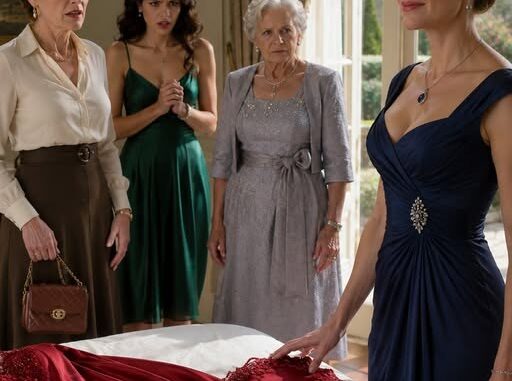
My sister ruined my outfit the night before I got married and texted me, saying, “Oops.” I suppose the ugly bride goes well with the awful outfit. I was overreacting, according to my mother. I refrained from crying. I called my insurance company after picking up my phone. Two cops were at her door the next day.
I’m 31-year-old Lorie LeChance. The night before I was scheduled to walk down the aisle, my sister ripped my wedding gown to pieces six months ago. She emailed me a picture of the damage along with the words, “Oops.” I suppose the ugly bride goes well with the awful outfit. My mother told me I was being dramatic after glancing at the damaged garment and then at me. I said nothing.
Rather, I got in touch with the insurance company I had been working with since I was a graduate. Two officers showed up at my sister’s house in less than a day. I should have let it go “for family peace,” according to my mother. She was unaware that my sister’s actions that evening were only the first signs of the damage, not the start of it.
Years in the insurance industry alter your perspective. You begin to see intent and cease to believe in coincidence. Like bank records, you read homes, people, and relationships, searching for missing entries, altered lines, and contradictions.
For almost thirty years, my family had been rewriting my place in it. I just hadn’t begun recording it until November of that year. With roots in Bristol and Newport, I was raised in a well-known Rhode Island family that combined ancient New England customs with French-Canadian ancestry. The house my grandmother purchased in the early 1960s is still where she resides. 2018 saw the death of my father following a stroke.
Once a longtime headmistress of a private school, my mother retired early and devoted all of her time to determining which daughter was deserving of love at any particular moment. That was always my sister Brooke’s preference, even though she was three years younger. It was she who received accolades and an apology. It was me who was corrected.
My grandmother gave me inherited pearl earrings when I was sixteen. Years later, my sister lost them, and I was ordered to stop bringing it up. She wore those same earrings to my wedding rehearsal dinner ten years later, as if nothing had happened. I saw right away. I remained silent.
It’s crucial to realize that I observe everything, yet I hardly ever react until absolutely necessary.
At Mansfield Keats Mutual, I rose to the position of senior underwriter with a focus on expensive personal goods like jewelry, dresses, and artwork. I insure items that are difficult for people to replace, giving emotional loss a monetary value.
I insured my own outfit for $18,500 two weeks before to my wedding. My grandmother’s veil, an heirloom worth $6,200, was later covered. Nathan, my fiancé, is a calm, methodical, and calculated corporate lawyer in Boston.
We scheduled the rehearsal for November 21 and the wedding for November 22 at a seaside home near Newport. Due to illness, my grandma was unable to attend the rehearsal, but she did send a wrapped box with a handwritten letter that said to open it only if absolutely necessary. I haven’t yet opened it.
That evening, over supper, my sister made a toast while wearing champagne silk. Under the pretense of humor, her remarks were scathing, suggesting that I had finally given up attempting to manage everything and let someone else to take charge of my life. People chuckled. I didn’t.
Throughout the evening, my mother kept saying, “We don’t create scenes,” as though keeping quiet was a kind of punishment. In addition, I saw that my mother was carrying a clutch that contained a keycard that she shouldn’t have. I disregarded it. I was overanalyzing, I told myself.
I strolled over to the bridal suite later that evening. The lights were on.
My clothing had been surgically damaged inside. Cutting is purposeful, organized, and nearly methodical rather than haphazard. They had opened every seam. The veil was torn. Scissors were neatly positioned close by, as though they had been left there on purpose.
I tallied the wounds. Forty-one. Each and every one of them matched the structural seams. This was planning, not wrath.
Before I touched anything, I took pictures of it all. A few seconds later, my maid of honor showed up, looking as well-trained as I did. She departed to summon hotel staff after telling me not to disturb the scene. I remained in the doorway.
Then I saw a message from my sister on my phone. “Ugly bride, ugly dress.” She awaited a response. I didn’t give her any.
When my mother got there, she said it was “just fabric” after observing the situation. She declined to inquire about what transpired. Rather, she demanded that we go to bed and take care of it in the morning.
She gave me some tea. I abstained from drinking it.
I opened my insurance binder and made the call when she was gone. I reported that the destruction was intentional. The claim was opened right away. The inquiry phase of the procedure then began.
Camera video, keycard records, and security logs were extracted. Evidence soon revealed patterns of movement that were not coincidental. Hours before, my sister had come into the suite. My mom had been observed granting access.
The case was already categorized as intentional harm by early morning. Attorneys got involved. My fiancé got in touch with his lawyer. The estate was completely cooperative.
I went through emails I was not supposed to see before dawn. My mother and sister talked “teaching me a lesson” in their messages, portraying the devastation as a deliberate emotional corrective rather than an accident. Planned weeks in advance, the terminology was exact.
It was more than just a dress at that moment. It has to do with written purpose.
My grandmother drove through the night and arrived before sunrise. At first, she didn’t ask any questions. She just observed everything, quickly assessed the situation, and silently shut down my mother’s laptop. Then she told me that for decades, something had been waiting to be recorded.
She pulled her own wedding dress out of storage. An heirloom that has been preserved. Instead, she demanded that it be changed for me.
I wore her dress instead of mine a few hours later.
That afternoon, the ceremony went on. My mom never came back. My sister was already being looked into. The wedding still took place, but the mood had shifted to one of final clarity rather than just celebration.
The insurance claim was then accepted. Payment has been made. Subrogation, the legal mechanism, then came into play. The insurer sought compensation from the accountable party.
My sister thought it ended in disgrace. It didn’t. It turned into long-term repercussions she didn’t foresee, financial accountability, and legal escalation.
Court cases and settlement talks had begun by early December. She was accused, given a plea deal, and made to pay back damages, go on probation, and agree to contact limitations.
Soon after, her reputation fell apart. Sponsorships came to an end. She became the target of negative online attention. My mother became much more silent.
Later, the family trust examined the circumstances in light of the conduct clauses. Financial benefits associated with the estate were taken away from my mother. The inheritance of my sister was limited to a conditional structure. Not emotionally, but legally, everything changed.
I remained constant throughout. I kept a record. I kept records. I let the system do what it was intended to do.
My grandmother’s veil was kept intact in a sealed box with the cuts still evident months later. Not as a representation of suffering, but as proof of what took place.
My life progressed. I got married. I restored normalcy. However, since recollection is not always trustworthy, I retained the records.
I was later asked if I regretted it. They anticipated a gentle response. I didn’t offer it.
A wedding dress is more than just a piece of apparel; it symbolizes a public declaration of identity. Mine was purposefully destroyed. Emotional collapse was not the reaction. It was paperwork.
I do that. I always did that.
Lorie LeChance Beaumont is my name. I’m thirty-one. And I stopped letting my family change my reality the night my wedding dress was ruined.
Leave a Reply